


What Happened to All the Questions

What Happened to All the Questions

There is a version of your child you may have half-forgotten.

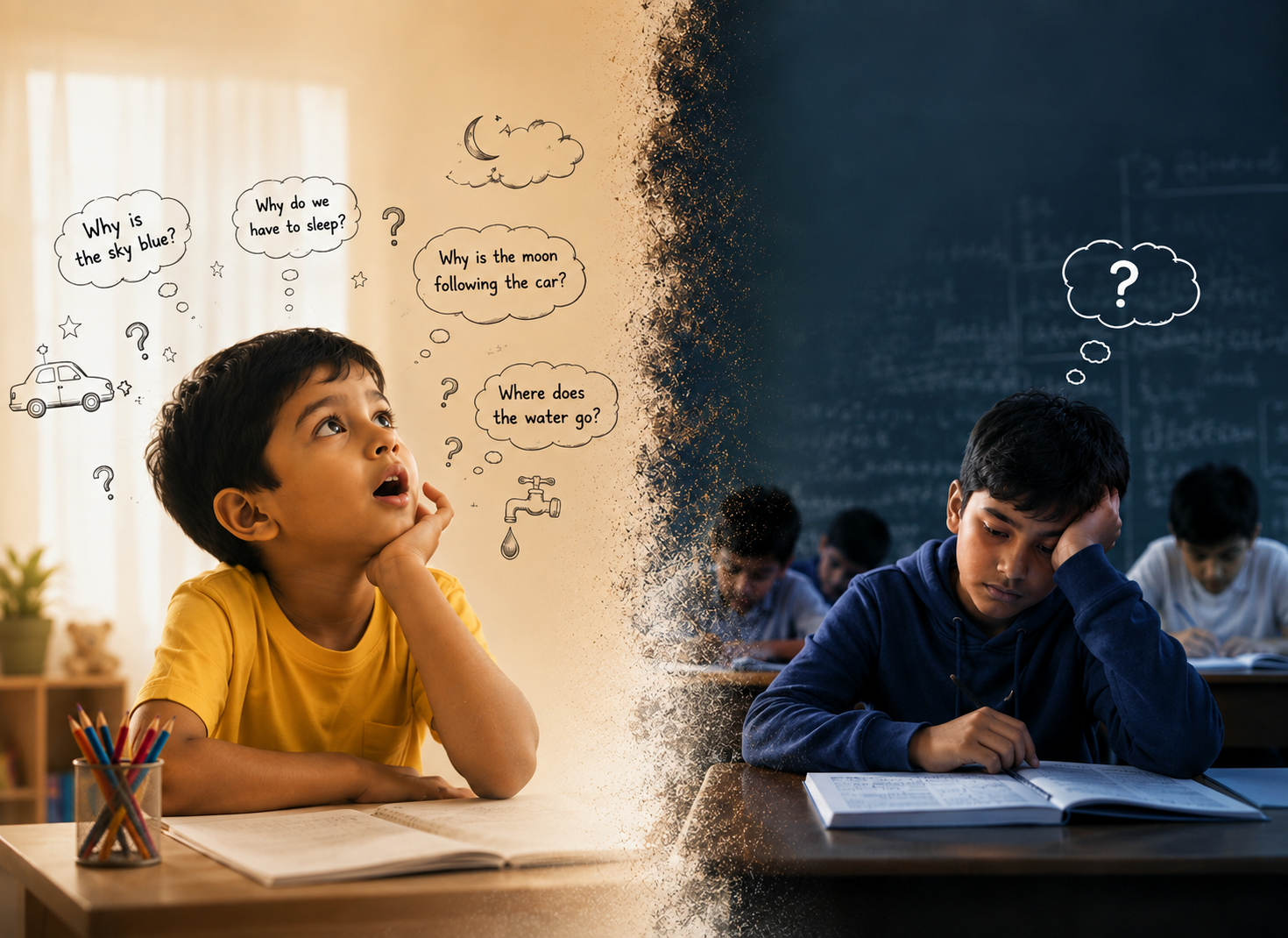
The one who, at four years old, asked why about everything. Why is the sky blue. Why do we have
to sleep. Why is the moon following the car. Where does the water go. Why, why, why a
hundred times a day, until you were tired and a little amazed and quietly running out of answers. That child wasn’t being difficult. That child had
the single most powerful engine of learning ever discovered, running at full throttle. Every “why” was a mind reaching out to grab hold of the world.

So here is the question we at Be Brainy cannot stop thinking about:

Where did all those questions go?
Because somewhere between four and fourteen, they stop. Not all at once. Quietly. A child raises
a hand to ask something that isn’t on the syllabus, and learns from a sigh, from a “we’ll
cover that later,” from a “just remember it for the exam”  that the question was in the way.
It happens a hundred small times. And a child is a fast learner. They pick up the real lesson underneath all the other lessons: don’t wonder.
Don’t wander. There isn’t time. Just take the answer, memorise it, and give it back exactly the
way it was given to you.

And so, slowly, the most curious creature on earth is trained into a filing cabinet. This is the flaw. Not a small one. The single deepest crack in how we teach: we built a system to deliver answers, and somewhere along the way it decided the question was the problem. We reward the child who can repeat. We quietly sideline the child who wonders. We have made “why?” — the most important word a human being can say — into an interruption. Sit with what that costs.

Somewhere Along the Way, We Forgot How Children Learn

We end up with children who can recite the water cycle but have never once stood in the rain and wondered. Who can name the parts of a flower for the exam and could not care less about the flower. Who score well and feel nothing. We are producing minds that are full and switched off.

And the cruelest part is what it does to a child’s sense of themselves. A child bursting with questions, told again and again that questions don’t count, doesn’t conclude “this system is broken.” A child concludes “I am the problem.” The wondering ones start to feel slow. The dreamers start to feel like they don’t belong. We take the very children whose minds are most alive, and we teach them to go quiet. At Be Brainy, we started from a stubborn refusal to accept this. And we built everything — every game, every session, every single thing we make — around one reversal.

We’re Not Making Learning Easier. We’re Making It Matter Again.

We put the question back at the centre. We don’t begin with the answer and ask a child to hold it. We begin with something that makes them lean in — a puzzle that doesn’t quite make sense yet, a “wait, that can’t be right,” a small mystery they suddenly need to solve. We treat “why?” not as the thing slowing the lesson down, but as the lesson finally starting. Because a child who wants to know something will move mountains to find out. A child who has merely been told to remember it will forget it by Friday. It is not a gentler kind of learning. It is a far more demanding one — because a curious child asks harder questions than any exam ever will. We’re not making learning easier. We’re making it matter again. We’re handing children back the one thing school so often takes: permission to wonder out loud.

That’s the whole of it. We are not here to help children score two marks more. We are here because a four-year-old’s endless “why” is the most precious thing a human mind ever does — and we are not willing to watch it get switched off.

So we’ll leave you with the thought we can’t put down.

Imagine a child who never had to stop asking. Who reached ten, fourteen, eighteen, with that four-year-old engine still running — sharpened, not silenced. What if a raised hand full of curiosity was the most welcome thing in the room, instead of the inconvenient one? What if “I don’t understand” was celebrated as the beginning of thinking, instead of hidden as the sign of a slow child? What if we protected the question the way we currently protect the syllabus? What would that child grow into? What would they build, solve, imagine, become — if we had simply never taught them to go quiet? We don’t think that’s a fantasy. We think it’s a choice. And we think it starts with one small, world-changing decision, made by one parent, one teacher, one child at a time: Keep asking why. We’ll spend everything we have making sure someone is finally glad you did.

Be Brainy Blog 1 Image 1
Be Brainy Blog 1 Image 2

Leave A Comment

Recent Posts

Recent Posts

Cart (0 items)